General Cable Resources & Buyer Guides

Everything you need to choose, install, and maintain your cable infrastructure — all in one place.

Cable selection guide
Most Popular

Cable Selection Guide

Not sure whether you need single-mode or multi-mode fiber? Cat6 or Cat6A? Our interactive selection guide walks you through five key questions to narrow down the right cable type for your application.

Download Guide
Installation tutorials
Step-by-Step

Installation Tutorials

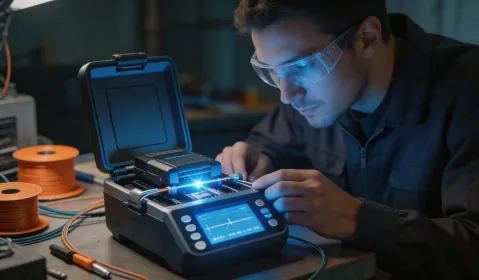
Video and written guides covering fiber splicing, cable pulling best practices, bend radius management, and termination techniques for all our cable types.

View Tutorials

Specification Sheets & Comparisons

Download detailed datasheets or compare cable specifications side by side.

Fiber Cable Datasheets

Complete specifications for single-mode, multi-mode, ribbon, and specialty fiber cables including attenuation, bandwidth, and temperature ratings.

Request Datasheets →

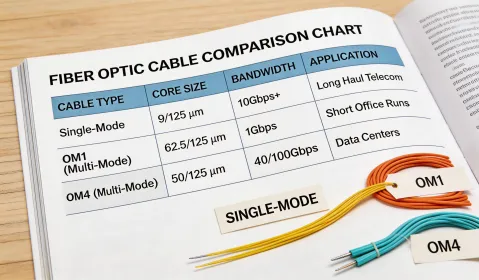
Cable Comparison Charts

Side-by-side comparisons of Cat5e vs Cat6 vs Cat6A, OM3 vs OM4 vs OM5, and coaxial cable grades for your reference.

View Charts →

Compliance Certificates

Download ISO 9001, UL, RoHS, REACH, and IATF 16949 compliance certificates for procurement documentation.

Download Certificates →

Common Questions

Single-mode fiber (9/125 μm core) supports longer distances (up to 80+ km) and higher bandwidth, ideal for backbone and long-haul links. Multi-mode fiber (50/125 μm core) is cost-effective for short-reach data center and campus links up to 550 m (OM4) or 400 m (OM3).

Choose Cat6A when you need 10 Gbps speeds over distances up to 100 meters, or when deploying PoE++ (Type 4, up to 90W). Cat6 supports 10 Gbps only up to 55 meters and handles PoE+ (Type 3, up to 60W). Cat6A is also better shielded against alien crosstalk in dense cable bundles.

This is one of the most debated topics in network planning, and there is no universal answer.

The case for full fiber (FTTH/FTTP): Fiber offers future-proof bandwidth capacity (symmetrical gigabit and beyond), lower long-term maintenance costs since passive optical components have no powered field equipment to fail, and superior latency for latency-sensitive applications like 5G backhaul and cloud computing.

The case for enhanced copper / hybrid: Technologies like G.fast (up to 1 Gbps over short copper loops) and VDSL2 vectoring allow operators to leverage existing copper infrastructure with significantly lower upfront deployment cost and faster rollout timelines. For buildings already wired with copper, a hybrid approach — fiber to the building, copper to the desk — often delivers sufficient bandwidth for current demand at 30-50% lower capital expenditure.

Our recommendation: Evaluate your 10-year bandwidth roadmap. If projected demand exceeds 1 Gbps symmetrical per subscriber, fiber is the more economical choice over a full lifecycle. For shorter planning horizons or brownfield sites, enhanced copper can be a pragmatic interim solution. We manufacture both fiber and copper cables and can provide a cost comparison for your specific deployment scenario.
AON advantages: Each subscriber gets dedicated bandwidth (no contention ratio), reach extends up to 80 km without amplification, and troubleshooting is simpler because each link is independent. AON suits enterprise and campus deployments where guaranteed SLA bandwidth matters.

PON advantages: Passive splitters require no field power, reducing operational costs by an estimated 20-30% over AON. The simpler outside plant with fewer active components means less maintenance. GPON and XGS-PON are the dominant choice for high-density residential FTTH because the shared infrastructure model delivers better economics at scale.

Key decision factor: If your deployment serves fewer than 500 subscribers per node and SLA guarantees are critical, AON may justify the higher per-subscriber cost. For mass residential rollout exceeding 1,000 premises, PON is almost always more cost-effective. Our fiber cables and splitters support both architectures.

For standard single-mode fiber: minimum bend radius is 10x the cable outer diameter under no load, 20x under tension. For bend-insensitive fiber (ITU-T G.657.A2): 7.5 mm radius allowed. For Cat6A copper cable: 4x the cable diameter. Exceeding these limits causes signal attenuation and potential cable damage.

Still Have Questions?

Our technical team is happy to help you find the right cable for your project.

Contact Our Engineers