Industries Served by General Cable

We supply cables and wiring solutions to six core sectors. Explore how our products support your specific industry requirements.

Telecommunications

Telecommunications

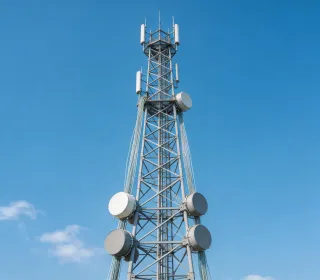
Backbone fiber for long-haul networks, FTTH drop cables, aerial self-supporting cables, and high-count ribbon cables for carrier-grade deployments.

  • Up to 864-core ribbon fiber
  • Span lengths up to 1,200 m (aerial)
  • ITU-T G.652.D / G.657.A2 compliant
Get a Telecom Cable Quote →
Data Centers

Data Centers

High-density OM5 multi-mode fiber, MTP/MPO trunk cables, DAC/AOC assemblies, and Cat6A copper for spine-leaf and top-of-rack connectivity.

  • OM5 wideband multimode fiber
  • MTP-12/24 trunk assemblies
  • Plenum and riser rated
Explore Data Center Cables →
Industrial Automation

Industrial Automation

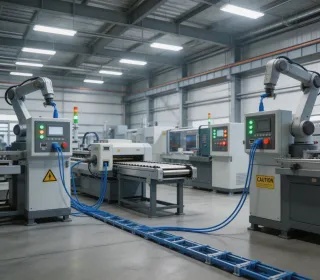
Ruggedized Industrial Ethernet cables, fieldbus cabling (PROFINET, EtherNet/IP), and armored fiber for factory floors, oil platforms, and mining operations.

  • IP67 rated connectors available
  • -40°C to +105°C operating range
  • Oil/chemical resistant jackets
Request Industrial Specs →
Broadcasting

Broadcasting & Media

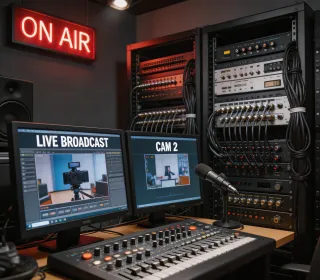
Low-loss coaxial cables, triaxial camera cables, and SMPTE fiber-hybrid cables for live production, OB vans, and studio signal routing.

  • SMPTE 311M hybrid cables
  • 12G-SDI compatible coax
  • Flexible deployment reels
Get a Broadcast Cable Quote →
Transportation

Transportation

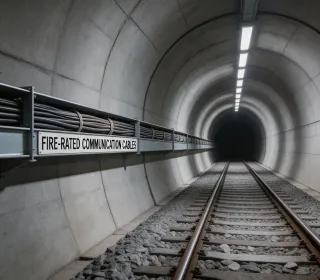
Fire-rated LSZH cables for tunnels, rail signaling cables, airport baggage system cabling, and highway ITS fiber networks.

  • EN 50575 CPR Euroclass B2ca
  • Low smoke zero halogen (LSZH)
  • Vibration-resistant designs
Discuss Transport Projects →
Commercial Buildings

Commercial Buildings

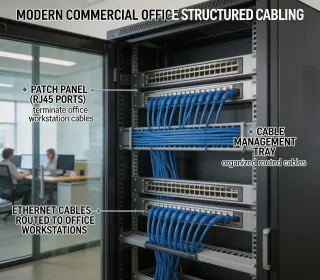
Structured cabling systems including Cat6A horizontal cabling, fiber backbone, and plenum-rated cables for office towers, hospitals, and universities.

  • TIA-568 / ISO 11801 compliant
  • 25-year performance warranty
  • PoE++ (90W) compatible
Plan Your Cabling System →

Cable Selection Considerations & Limitations

Every cable type involves trade-offs. Understanding these limitations helps you make the right choice for your specific environment.

Fiber Optic Cable Limitations

  • Bend sensitivity: Standard G.652.D single-mode fiber suffers measurable signal loss below a 30 mm bend radius. Even bend-insensitive G.657.A2 fiber has a hard minimum of 7.5 mm. Tight routing in building risers or patch panels requires careful pathway planning.
  • Splice and connector loss budget: Each mechanical splice adds 0.1-0.5 dB of insertion loss; fusion splices add 0.02-0.05 dB. On long-haul links, cumulative splice loss can consume a significant portion of your optical budget — a 100 km link with 50 splices at 0.05 dB each loses 2.5 dB to splices alone.
  • Temperature range: Standard outdoor cables are rated -40°C to +70°C. Environments exceeding this range (e.g., near furnaces, in desert direct burial) require specialty high-temperature jackets, which increase cost by 25-40%.

Copper Cable Limitations

  • Distance constraints: Cat6A supports 10 Gbps only up to 100 meters per TIA-568. Beyond this distance, signal attenuation and alien crosstalk degrade performance. Fiber is the only option for runs exceeding 100 m at 10G+ speeds.
  • EMI susceptibility: Unshielded copper cables (UTP) are vulnerable to electromagnetic interference from motors, transformers, and fluorescent lighting. Industrial environments typically require shielded (STP/FTP) variants, adding 15-20% to material cost and requiring grounded shielding termination.
  • Weight and space: A 24-strand Cat6A copper bundle weighs approximately 3x more than a 24-fiber optical cable of equivalent capacity. In data centers with limited cable tray space, this difference affects airflow management and structural load calculations.

Need a Cable Solution for Your Industry?

Tell us your application and we will recommend the right cable type within 24 hours.

Talk to Our Team